
Tutorials
Protocols
Learn More
AXI Transactions
An AXI transaction is a full operation, not merely one cycle. A read transaction consists of one read request plus one or more read data transfers. A write transaction consists of one write request, one or more write data transfers, and one write response. Some special transactions are data-less or use additional response forms, but the same channel discipline remains.
The useful distinction is between a transfer and a transaction:
| Term | Meaning | Example |
|---|---|---|
| Transfer | One accepted movement on one channel. In Valid-Ready transport, this is one cycle where VALID and READY are both HIGH. | One AW request transfer, one W data beat, or one R data beat. |
| Transaction | The complete protocol operation formed from one or more related channel transfers. | A write transaction is AW plus all required W beats plus one B response. |
The request channel describes the whole transaction. AxADDR, AxSIZE, AxLEN, and AxBURST tell the Subordinate how many data transfers are expected, how many bytes each transfer can carry, and how the address changes from beat to beat. The data channels then carry the actual write data or read data beats that belong to that request.
Write Transaction
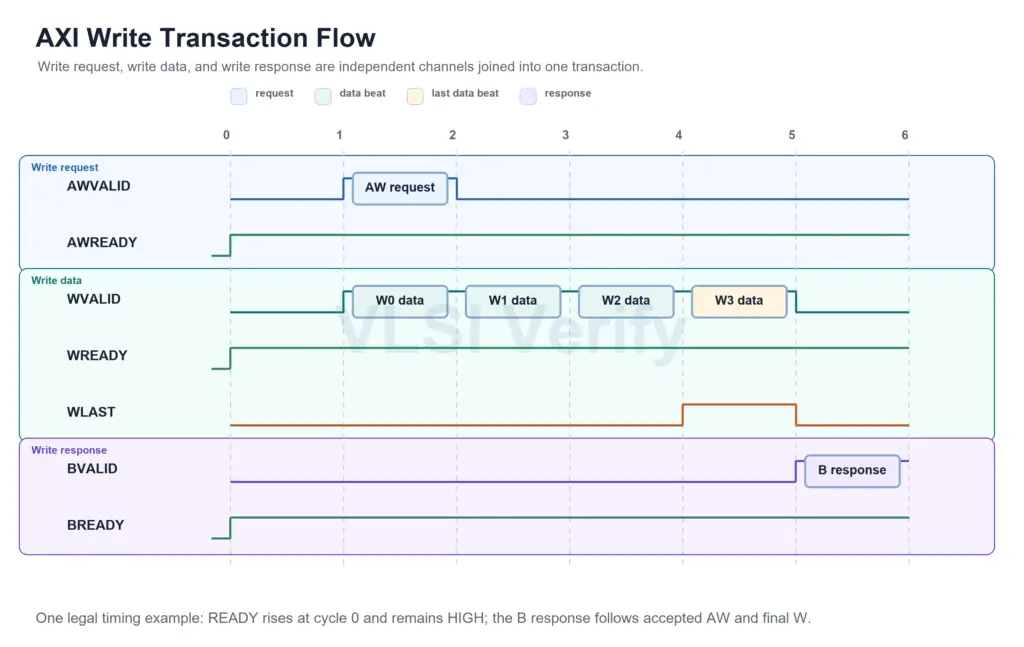
A write transaction starts with an AW request and completes with a B response. The W channel carries the data beats. WLAST marks the final write data transfer when present. The write response indicates completion for the transaction, not for each data beat.
| Write step | Channel | What moves | Key point |
|---|---|---|---|
| Write request | AW | Address, burst shape, size, length, ID, and attributes. | Describes the complete write transaction. |
| Write data | W | One or more data beats with WDATA, WSTRB, and WLAST. | Data can be accepted independently of AW; WSTRB selects valid byte lanes. |
| Write response | B | BRESP and BID. | One response completes the write transaction after the request and final data beat are accepted. |
AW and W do not have to arrive in the same cycle. Register stages can make write data reach an interconnect before the write request, or the two channels can arrive together. The design must therefore match write data to the correct write request before forwarding it to the target Subordinate.
Read Transaction
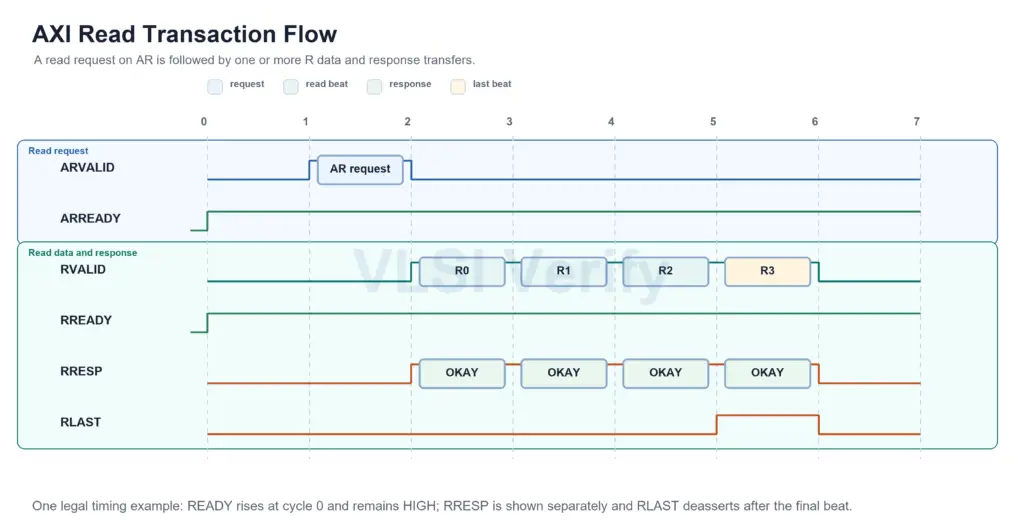
A read transaction starts with an AR request. The R channel returns data and response information. Each read data beat carries RRESP, and RLAST marks the final beat when present.
| Read step | Channel | What moves | Key point |
|---|---|---|---|
| Read request | AR | Address, burst shape, size, length, ID, and attributes. | Describes the complete read transaction. |
| Read data and response | R | One or more data beats with RDATA, RRESP, RID, and RLAST. | Every read data beat carries response status, and RLAST marks the final beat. |
Unlike writes, reads do not have a separate response-only channel. The response travels with the data on R. A multi-beat read can therefore report response information on each beat, while the transaction is still considered complete only when the final read data beat has been transferred.
AXI Protocol