
Tutorials
Protocols
Learn More
AXI Transport
AXI transport describes how each channel moves one transfer from a transmitter to a receiver. The protocol defines a global clock and reset per interface, then lets the interface choose one of two transport styles: Valid-Ready transport or credited transport.
Clock
Every AXI interface has one clock, ACLK. Inputs are sampled on the rising edge of ACLK, and output signal changes occur only after the rising edge. The specification forbids combinatorial paths between input and output signals on an interface. That rule is not cosmetic; it is what lets designers insert register stages and close timing without creating unstable feedback paths.
Reset
AXI uses an active-low reset, ARESETn. Reset can assert asynchronously, but deassertion must be synchronous to a rising edge of ACLK. Signals that must be deasserted during reset, such as VALID, must remain deasserted until at least the rising edge after ARESETn is sampled HIGH.
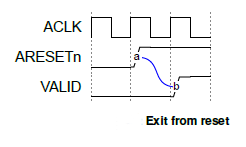
AXI transport options
The AXI_Transport property selects the transport style used by all AXI channels on an interface. Connected Manager and Subordinate interfaces must use the same transport style. The Ready value selects Valid-Ready transport; the Credited value selects credited transport and is available for AXI5 interfaces.
| AXI_Transport | Default | Description |
|---|---|---|
| Credited | AXI channels use CRDT flow-control signals. | |
| Ready | Y | AXI channels use READY flow-control signals |
Valid-Ready transport
Valid-Ready transport is the default AXI transport. As listed in Signal Description, each channel has a VALID side and a READY side. This section focuses on the timing rule: a transfer occurs on a rising ACLK edge when both are HIGH.
The transmitter must not wait for READY before asserting VALID. Once VALID is asserted, it must remain asserted until a transfer occurs. The receiver is allowed to wait for VALID before asserting READY, and it is also allowed to assert READY before VALID.
VALID before READY
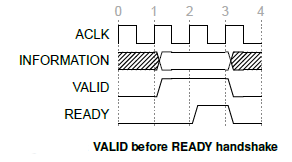
In this timing example, the transmitter presents information and asserts VALID before the receiver asserts READY. The payload must remain stable until the rising edge where VALID and READY are both HIGH.
READY before VALID
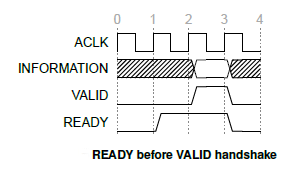
In this example, the receiver is already ready before the transmitter asserts VALID. When the transmitter presents valid information, the transfer can complete with minimum latency.
Dependencies between channel handshake signals
There are dependencies between channels for write, read, and snoop transactions. In the dependency diagrams, a single-headed arrow means the signal at the arrowhead can be asserted before or after the signal at the start of the arrow. A double-headed arrow means the signal at the arrowhead must be asserted only after the signal at the start of the arrow.
Write transaction dependencies
The write path has three channels: AW, W, and B. AXI allows the write request channel and write data channel to be accepted independently. Write data can arrive before, with, or after the write request, depending on register stages and implementation.
The key dependency is the write response. A Subordinate must not assert BVALID until it has accepted the write request and the final write data transfer. The final write data transfer is identified by WLAST when WLAST is present.
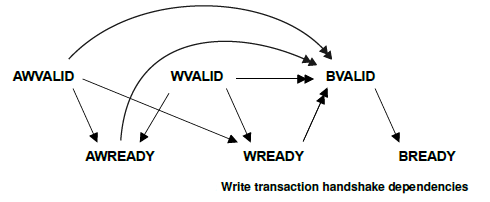
The key idea is that 'AW' and 'W' can make progress independently, but the 'B' response depends on the accepted write request and the final accepted write data transfer.
| Dependency point | Rule |
|---|---|
| Manager drives write request/data | The Manager must not wait for the Subordinate to assert AWREADY or WREADY before asserting AWVALID or WVALID. This applies to every write data transfer in a transaction. |
Subordinate drives AWREADY after seeing valid | The Subordinate can wait for AWVALID or WVALID, or both, before asserting AWREADY. |
Subordinate drives AWREADY early | The Subordinate can assert AWREADY before AWVALID or WVALID, or both, are asserted. |
Subordinate drives WREADY after seeing valid | The Subordinate can wait for AWVALID or WVALID, or both, before asserting WREADY. |
Subordinate drives WREADY early | The Subordinate can assert WREADY before AWVALID or WVALID, or both, are asserted. |
| Write response waits for request and data handshakes | The Subordinate must wait for AWVALID, AWREADY, WVALID, and WREADY to be asserted before asserting BVALID. |
| Write response waits for final data beat | The Subordinate must wait for the last write data transfer before asserting BVALID. The last write data transfer has WLAST asserted. |
| Subordinate drives write response | The Subordinate must not wait for the Manager to assert BREADY before asserting BVALID. |
| Manager accepts response after valid | The Manager can wait for BVALID before asserting BREADY. |
| Manager accepts response early | The Manager can assert BREADY before BVALID is asserted. |
Read transaction dependencies
The read path has two channels: 'AR' and 'R'. The Subordinate must not return read data before the read request has been accepted. The Manager must be able to accept read data for a request it issued, without relying on unrelated transactions.
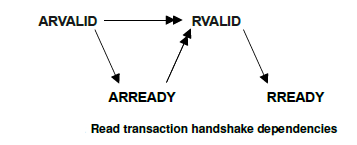
The request handshake on 'AR' must complete before the Subordinate can return valid read data on 'R'.
| Dependency point | Rule |
|---|---|
| Manager drives read request | The Manager must not wait for the Subordinate to assert ARREADY before asserting ARVALID. |
Subordinate drives ARREADY after seeing request | The Subordinate can wait for ARVALID to be asserted before it asserts ARREADY. |
Subordinate drives ARREADY early | The Subordinate can assert ARREADY before ARVALID is asserted. |
| Read data waits for accepted request | The Subordinate must wait for both ARVALID and ARREADY to be asserted before it asserts RVALID to indicate that valid data is available. |
| Subordinate drives read data | The Subordinate must not wait for the Manager to assert RREADY before asserting RVALID. |
| Manager accepts read data after valid | The Manager can wait for RVALID to be asserted before it asserts RREADY. |
| Manager accepts read data early | The Manager can assert RREADY before RVALID is asserted. |
Read data can be delayed, and different IDs can permit interleaving or out-of-order completion, but every returned RID must match the ARID of the request being completed.
Credited transport
Credited transport is an AXI5 option. Instead of READY, the receiver gives credits using CRDT signals. The transmitter can assert VALID only when it owns the appropriate credit. A credit cannot be used in the same cycle it is given, and a credit cannot be given in the same cycle it is used for a transfer.
Credited transport signals
Credited channels can include:
| Signal | Source | Meaning |
|---|---|---|
VALID | Transmitter | One transfer is being sent. |
PENDING | Transmitter | A transfer might occur in the following cycle. Useful for transfer-level clock gating. |
RP | Transmitter | Resource Plane number when more than one Resource Plane exists. |
SHAREDCRD | Transmitter | Transfer uses a shared credit. |
CRDT | Receiver | Gives one dedicated credit for a Resource Plane. |
CRDTSH | Receiver | Gives one shared credit. |
Credited flow control
In credited transport, a credit is permission to send one future transfer. The receiver owns the buffering, so it decides when to give credits. The transmitter keeps a small credit count for each channel and Resource Plane, then sends VALID only when the appropriate count is nonzero.
| Event | Effect at transmitter | Important rule |
|---|---|---|
| Reset active | Dedicated and shared credit counts are zero. | CRDT and CRDTSH are LOW during reset. |
CRDT[n] asserted | Adds one dedicated credit for Resource Plane n. | A credit cannot be used for a transfer in the same cycle it is given. |
CRDTSH asserted | Adds one shared credit. | Shared credits are only present when the channel supports them. |
VALID asserted using a dedicated credit | Consumes one dedicated credit for the selected Resource Plane. | VALID is illegal if the selected Resource Plane has zero dedicated credits and no shared credit is used. |
VALID asserted using a shared credit | Consumes one shared credit and asserts SHAREDCRD. | The selected Resource Plane is still shown on RP when RP is present. |
The receiver must be able to give at least one dedicated credit per Resource Plane. It can give up to 15 credits per Resource Plane, and up to 15 shared credits when shared credits are supported. There must not be combinatorial paths between credit signals and other channel signals, so a design should treat credits as registered state.
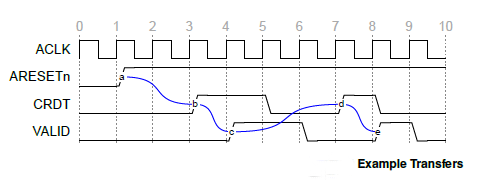
A simple credited-transfer waveform is easiest to understand by tracking the transmitter credit count. The labeled points map as follows:
| Point | Signal event | Credit-count view |
|---|---|---|
a | ARESETn is released. | The transmitter still owns zero credits after reset, so VALID remains LOW. |
b | The receiver asserts CRDT. | One credit is given to the transmitter. This credit is for a later cycle, not for a same-cycle transfer. |
c | The transmitter asserts VALID. | The transmitter uses a credit it already owns. In the shown example, VALID remains HIGH for two cycles, so two transfers consume two previously given credits. |
d | The receiver asserts CRDT again. | A credit is returned after receiver space is available again. The transmitter records it for a later transfer. |
e | The transmitter asserts VALID again. | The transmitter uses the returned credit from d on a later cycle. |
The main lesson is that CRDT is a promise for a future transfer, not a same-cycle READY signal. A transmitter must already own a credit before it asserts VALID.
Resource Planes
Resource Planes let traffic sharing one physical channel make progress independently. A Resource Plane is a flow-control partition inside a credited channel. It is not a new AXI channel and it does not create a separate address, data, or response path. Instead, it divides the channel credits into independent credit pools.
For example, an AW channel can carry requests from different traffic classes. If all requests shared one credit pool, a blocked class could consume or hold the only available buffering and stop another class from moving. With Resource Planes, each plane has its own dedicated credits. A transfer on Resource Plane 0 uses Resource Plane 0 credits, while a transfer on Resource Plane 1 uses Resource Plane 1 credits. This lets one plane make progress even when another plane has no available credits.
The RP signal identifies which Resource Plane a transfer belongs to. The receiver gives credits per Resource Plane using CRDT bits, and the transmitter must spend a credit from the same Resource Plane as the transfer. This is why Resource Planes are mainly a flow-control and deadlock-avoidance mechanism, not an ordering mechanism.
| Name | Values | Default | Description |
|---|---|---|---|
Num_RP_AWW | 1-8 | 1 | Number of Resource Planes on the AW and W channels. |
Num_RP_AR | 1-8 | 1 | Number of Resource Planes on the AR channel. |
AR, AW, and W can have multiple Resource Planes. B and R have one Resource Plane. If a channel has more than one Resource Plane, the RP signal identifies the Resource Plane used by the transfer. If a channel has one Resource Plane, the RP signal is absent.
| Resource Plane rule | Meaning |
|---|---|
| Different Resource Planes must not block one another between transmitter and receiver. | A stalled plane must not consume the only path for a different plane that has credit. |
| Credits are counted per Resource Plane. | A transmitter can issue on Resource Plane n only when it has credit for Resource Plane n, unless it uses a shared credit. |
AW and W for the same write transaction use the same Resource Plane number. | The write request and write data stay associated through the credited channel. |
| Different Resource Planes do not create ordering guarantees. | A Manager must not use the same ID for an outstanding transaction on the same channel with a different Resource Plane. |
| Write data for different transactions can be interleaved across Resource Planes. | Verification must track write data order per Resource Plane, not just globally. |
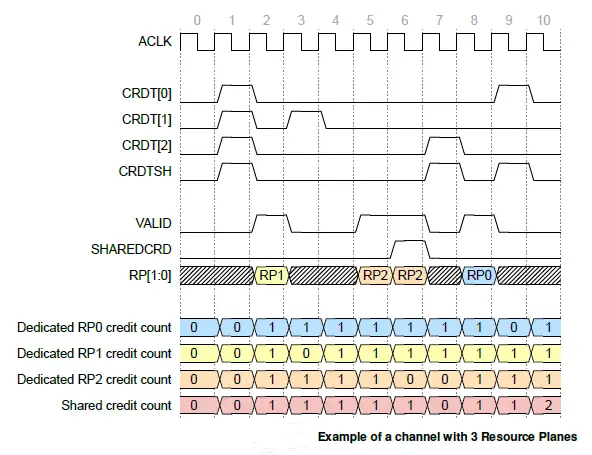
This example shows one credited channel configured with three Resource Planes and shared credits. The waveform is useful because it separates four related ideas: dedicated credits for each Resource Plane, shared credits that can be used by any Resource Plane, the RP value of each transfer, and the credit counters maintained by the transmitter.
| Cycle | What happens | What it teaches |
|---|---|---|
| 0 | The transmitter has no credits. | No transfer can be sent until the receiver gives credit. |
| 1 | The receiver gives one dedicated credit for each Resource Plane and one shared credit. | Each CRDT[n] bit increases the credit count for Resource Plane n; CRDTSH increases the shared credit count. |
| 2 | The transmitter sends a transfer on Resource Plane 1 using a dedicated credit. | VALID is HIGH, RP identifies Resource Plane 1, and SHAREDCRD is LOW because a dedicated credit is used. |
| 3 | The receiver gives a dedicated credit back for Resource Plane 1. | The receiver can return credit when it has space for another transfer on that Resource Plane. |
| 5 | The transmitter sends a transfer on Resource Plane 2 using a dedicated credit. | Dedicated Resource Plane 2 credit is consumed. |
| 6 | The transmitter sends another transfer on Resource Plane 2 using a shared credit. | SHAREDCRD is asserted because no dedicated Resource Plane 2 credit is available for that transfer. |
| 7 | The receiver gives back a shared credit and a dedicated Resource Plane 2 credit. | Shared and dedicated credits are counted separately. |
| 8 | The transmitter sends a transfer on Resource Plane 0 using a dedicated credit. | A different Resource Plane can make progress independently. |
| 9 | The receiver gives back a dedicated Resource Plane 0 credit and another shared credit. | Returned credits become available for later transfers. |
The most important point is that RP tells which Resource Plane the transfer belongs to, while SHAREDCRD tells which kind of credit is being spent. A transfer can use a shared credit and still belong to a specific Resource Plane.
Shared credits
Shared credits are optional for channels with multiple Resource Planes. They are a flexible credit pool that can be used by any Resource Plane. This improves buffer utilization when traffic is uneven, because an idle Resource Plane does not have to reserve all of its buffering while another Resource Plane is busy.
Shared credit properties
| Name | Values | Default | Description |
|---|---|---|---|
Shared_Credits_AW | True, False | False | If True, shared credits are supported on the AW channel using AWCRDTSH and AWSHAREDCRD. |
Shared_Credits_W | True, False | False | If True, shared credits are supported on the W channel using WCRDTSH and WSHAREDCRD. |
Shared_Credits_AR | True, False | False | If True, shared credits are supported on the AR channel using ARCRDTSH and ARSHAREDCRD. |
| Shared credit rule | Meaning |
|---|---|
| Shared credits require credited transport and multiple Resource Planes. | They are not used with Valid-Ready transport or with a single Resource Plane. |
CRDTSH gives one shared credit. | The receiver can give a shared credit without giving a dedicated CRDT credit in the same cycle. |
SHAREDCRD is asserted with VALID when the transfer consumes a shared credit. | The receiver can distinguish dedicated-credit transfers from shared-credit transfers. |
| A shared credit can be used for any Resource Plane. | The transfer still belongs to the Resource Plane indicated by RP. |
| Resource Plane independence still applies. | Shared credits must not let one Resource Plane block another in a way that violates the Resource Plane guarantee. |
If both a dedicated credit and a shared credit are available, a transmitter should normally use the dedicated credit first. The shared credit is more flexible and can be saved for a later transfer on a Resource Plane that has no dedicated credit.
Credited transport matters most in high-frequency designs where a simple READY feedback path is too timing-sensitive. It also changes ordering details: write data can be interleaved across transactions when those transactions use different Resource Planes.
Transfer-level clock gating
For credited transport, PENDING is a one-cycle look-ahead signal. It tells the receiver that a transfer might occur in the following cycle, so receiver-side logic can ungate its clock before VALID and payload signals arrive.
PENDING rule | Meaning |
|---|---|
There is one PENDING signal per channel. | It is channel-level, not per Resource Plane. |
PENDING must be HIGH in the cycle before VALID is HIGH. | The receiver gets one cycle of warning before a transfer. |
If PENDING is LOW, VALID must be LOW in the next cycle. | A transfer cannot appear without the look-ahead indication. |
If PENDING is HIGH, VALID is permitted but not required in the next cycle. | PENDING means “might transfer,” not “must transfer.” |
PENDING is independent of credits. | A transmitter can assert PENDING before it receives a credit, keep it HIGH permanently, or assert it and later deassert it without sending a transfer. |
Pipelining and register stages
AXI channels are independent and unidirectional. Register stages can be inserted on any channel, with an added cycle of latency. This lets a design trade latency for timing closure: a fast path to memory might have few stages, while a long path to a peripheral can add register slices.
| Pipelining rule | Meaning |
|---|---|
Any number of register stages can be inserted on VALID, READY, and CRDT paths. | AXI is designed to tolerate registered timing paths. |
| Different channels can have different numbers of register stages. | AW, W, B, AR, and R do not need matching latency. |
VALID and payload are pipelined together. | Address, data, control, RP, and SHAREDCRD must stay aligned with their VALID. |
PENDING keeps its timing relationship to VALID. | In credited transport, PENDING remains HIGH in the cycle before VALID is HIGH. |
This independence is powerful, but it forces real interconnects to be careful. The protocol does not require channels to keep the same-cycle timing relationship. Write data can arrive before the write request at an interface point if the AW path has more register stages than the W path. If an interconnect uses address decoding to determine where write data should go, it must realign AW and W before forwarding data to the selected Subordinate.
Key points
The relationships that must still be preserved are:
| Relationship | Required behavior |
|---|---|
| Write response after write data | A write response follows the last write data transfer of the write transaction. |
| Read data after read request | Read data and read response follow the accepted read request. |
| Manager write-data responsibility | After issuing a write request, the Manager must be able to provide all write data for that transaction without depending on other transactions from that Manager. |
| Manager response responsibility | After issuing a write request and all write data, the Manager must be able to accept all responses for that transaction without depending on other transactions from that Manager. |
| Manager read-data responsibility | After issuing a read request, the Manager must be able to accept all read data for that transaction without depending on other transactions from that Manager. |
| Data-less write requests | A Subordinate must not block data-less write requests because other transactions have leading write data. |
AXI Protocol