
Tutorials
Protocols
Learn More
APB Architecture
In a typical SoC, the APB side is reached through a bridge. The bridge receives a transaction from a higher-performance interconnect, decodes the target address, selects one APB peripheral, and drives the APB transfer sequence.
The bridge is the Requester. It drives request-side signals such as address, select, enable, direction, write data, strobe, and protection attributes. The selected peripheral is the Completer. It returns read data, ready, error, and optional response/user information.
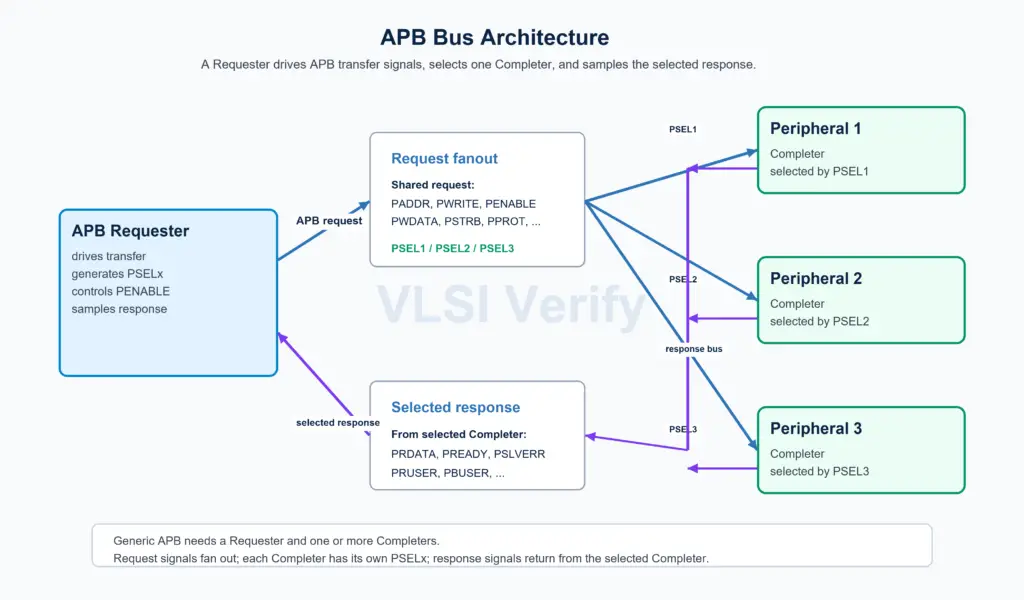
The important architectural idea is selection. APB uses a PSELx signal per Completer. A shared address/control/data path can be routed to many peripherals, but only the selected Completer participates in the active transfer.
Requester and Completer
| Role | Common implementation | Main responsibility |
|---|---|---|
| Requester | APB bridge, bus adapter, local controller | Starts transfers, drives address/control/write data, asserts PSELx and PENABLE |
| Completer | APB peripheral register block | Accepts writes, returns read data, controls PREADY, optionally reports PSLVERR |
Older material may use master/slave terminology. This tutorial uses Requester/Completer because that is the terminology used by the current APB specification.
APB bridge behavior
The APB bridge commonly performs these steps:
- Accept a request from AXI, AHB, or a local internal bus.
- Decode the address to choose the APB Completer.
- Assert the correct PSELx.
- Drive address, direction, write data, and attributes.
- Assert PENABLE in the Access phase.
- Wait for PREADY if the Completer needs extra cycles.
- Return read data or error status to the upstream bus.
APB itself does not define the upstream bus. AXI-to-APB and AHB-to-APB bridges are common implementation choices, but APB remains the simple peripheral-side protocol.
APB Protocol