
Signal Description
AHB signals are prefixed with H. The signal set can be understood in groups: global signals, Manager address/control signals, Manager write-data signals, Subordinate response signals, decoder signals, muxed response signals, and optional AHB5 features.
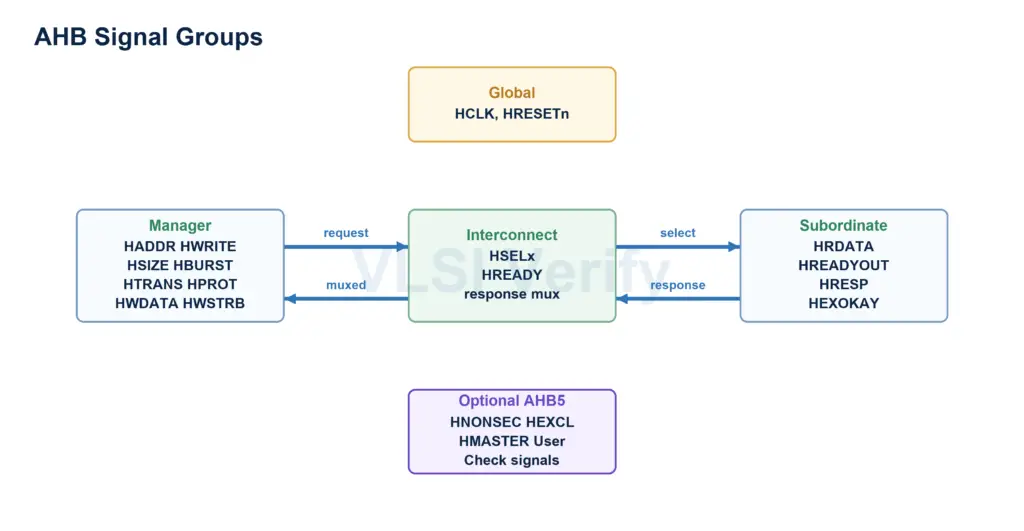
Global signals
| Signal | Source | Description |
|---|---|---|
| HCLK | Clock source | Bus clock. All protocol timing is related to the rising edge. |
| HRESETn | Reset controller | Active-low reset. This is the only active-low protocol signal. |
Manager-driven signals
A Manager provides address and control information to initiate read and write operations
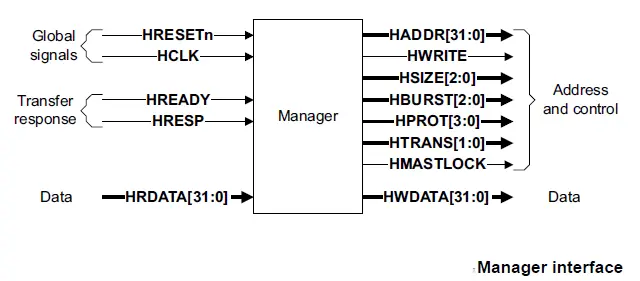
| Signal | Description |
|---|---|
| HADDR | Byte address of the transfer. Address width is configurable. |
| HWRITE | Transfer direction. HIGH means write, LOW means read. |
| HSIZE | Transfer size, such as byte, halfword, word, or wider. |
| HBURST | Burst type and burst length. |
| HTRANS | Transfer type: IDLE, BUSY, NONSEQ, or SEQ. |
| HPROT | Protection and memory attribute information. |
| HMASTLOCK | Indicates a locked transfer sequence. |
| HWDATA | Write data driven by the Manager during the data phase. |
| HWSTRB | Optional write strobes. One bit per write-data byte lane. |
Subordinate response signals
A Subordinate responds to transfers initiated by the Manager, using the HSELx select signal from the decoder to determine when to act.
To communicate the transfer’s status back to the Manager, the Subordinate signals:
Status/Extension: Whether the transfer is complete or needs to be extended.
Outcome: Whether the transfer succeeded or failed.
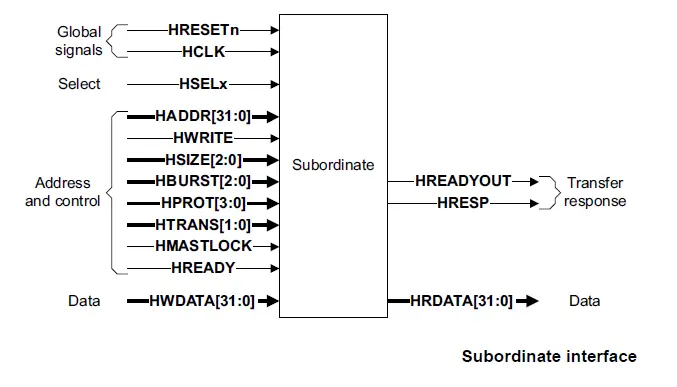
| Signal | Description |
|---|---|
| HRDATA | Read data from the selected Subordinate. |
| HREADYOUT | Subordinate output that indicates whether its data phase is complete. |
| HRESP | Transfer response. LOW is OKAY, HIGH is ERROR. |
Decoder and muxed interconnect signals
The interconnect component manages the connectivity between Managers and Subordinates. The system architecture scales based on the number of Managers:
Single-Manager Systems: Require only a centralized Decoder and Multiplexor (detailed below).
Multi-Manager Systems: Require an interconnect that handles arbitration and signal routing (address, control, and write data) from multiple Managers to the appropriate Subordinates.
| Signal | Description |
|---|---|
| HSELx | Decoder-generated select signal for a Subordinate. |
| HREADY | Muxed ready signal returned to the Manager and Subordinates. It is derived from the selected Subordinate response path. |
Decoder: Decodes transfer addresses to select the active Subordinate and outputs control signaling to the multiplexor.
Multiplexor: Routes the read data bus and response signals from the selected Subordinate back to the Manager, guided by the decoder’s control signals.
Optional AHB5 signals
These signals are present only when the corresponding interface feature is implemented, such as secure transfers, exclusive transfers, user sideband signaling, or interface protection using parity/check signals.
| Signal | Purpose |
|---|---|
| HNONSEC | Marks Secure or Non-secure transfers when secure transfers are supported. |
| HEXCL | Marks an exclusive transfer. |
| HMASTER | Manager identifier used with exclusive transfers. |
| HEXOKAY | Indicates success or failure of an exclusive transfer. |
| HAUSER | User-defined request attribute. |
| HWUSER | User-defined write-data attribute. |
| HRUSER | User-defined read-data attribute. |
| HBUSER | User-defined response attribute. |
| *CHK signals | Optional parity/check signals for interface protection. |
Signal width properties
Current AHB specifications describe many signal widths using properties. For example:
| Property | Applies to | Practical note |
|---|---|---|
| ADDR_WIDTH | HADDR | Commonly 32 bits, but configurable. |
| DATA_WIDTH | HWDATA, HRDATA | Can be wider than 32 bits in high-bandwidth systems. |
| HPROT_WIDTH | HPROT | Can be absent, 4 bits, or extended to 7 bits. |
| HMASTER_WIDTH | HMASTER | Used when exclusive transfer support needs Manager identity. |
| USER_*_WIDTH | User signals | Width 0 means the signal is not present. |
For RTL, treat these as parameters. Do not hard-code 32-bit address or data assumptions unless the local interface contract explicitly fixes those widths.
AHB Protocol